Where we start · the published record
01 / 05Fire prevention · Response · Infrastructure
The fire is not the problem.Everything around it is.
A fire in a hillside home does not stay in that home. It spreads because of the lane too narrow for an apparatus, the supply too far to reach, the wiring inside the wall. Fire Shield works on those conditions, alongside the firefighters and residents who live with them.
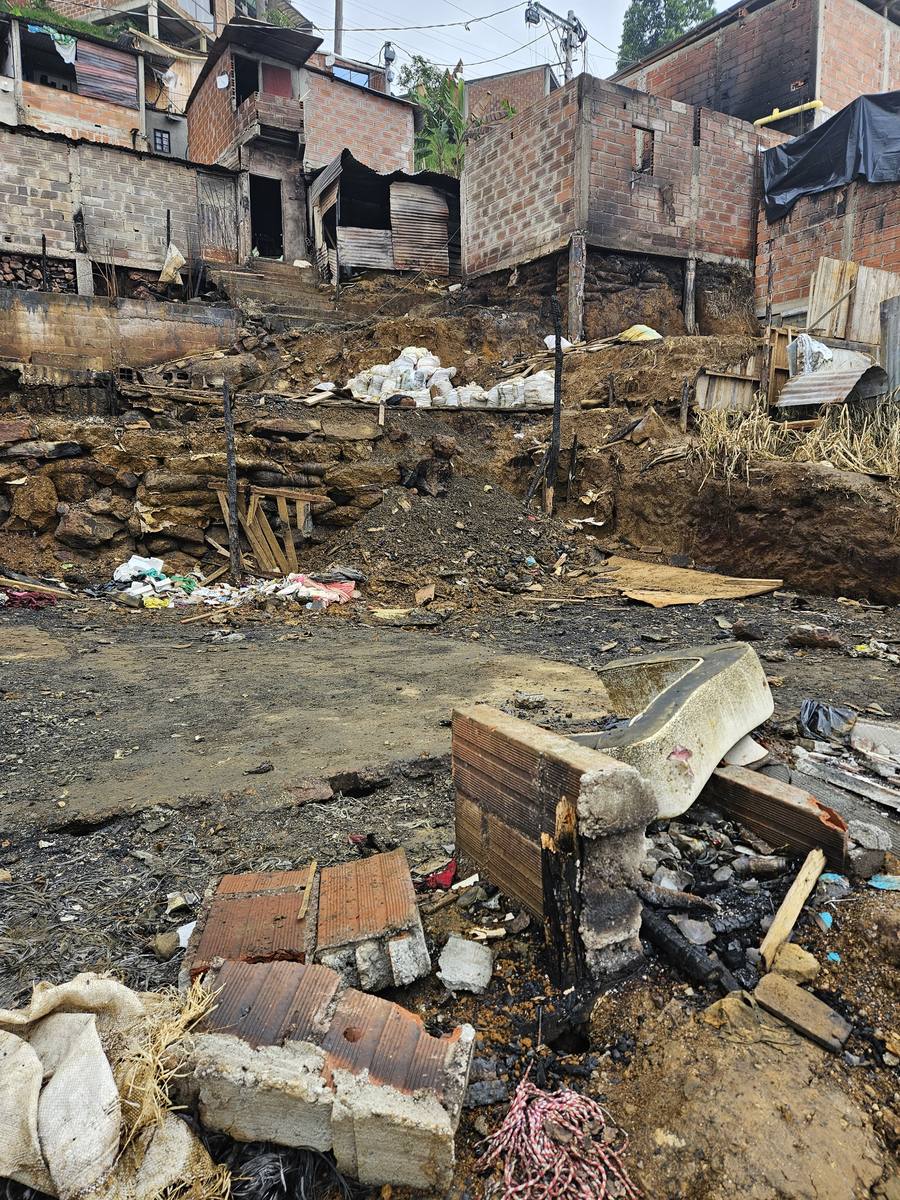
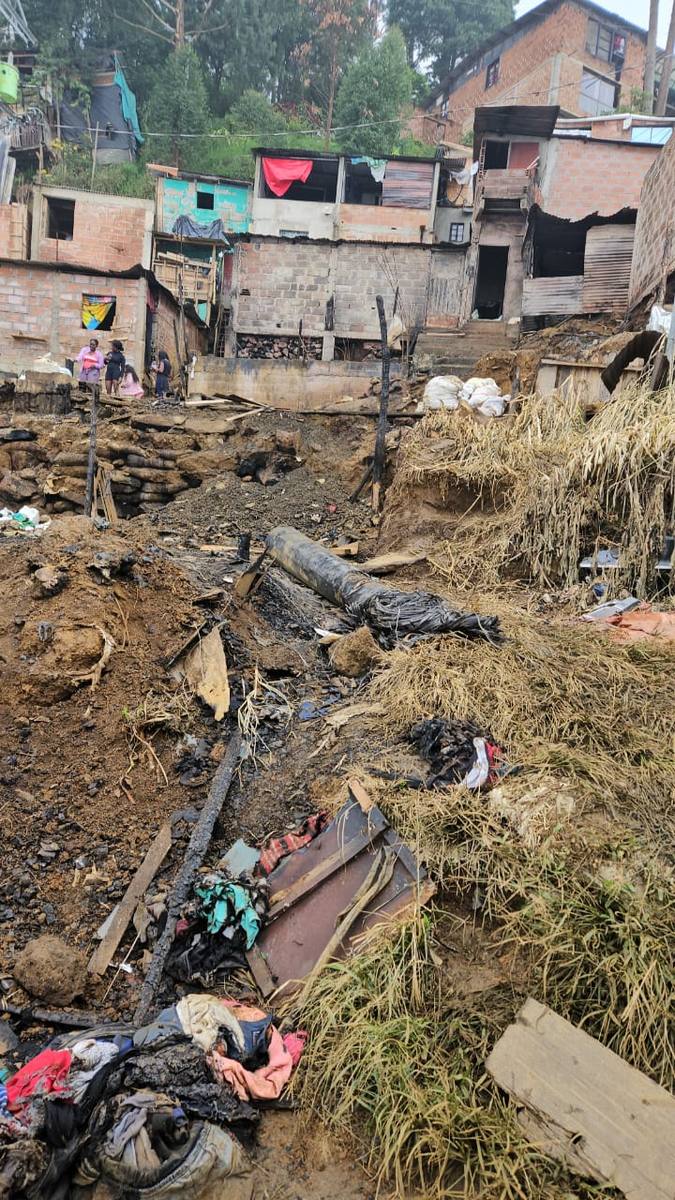
Structural fire site, hillside community, Medellín. Fire Shield Foundation field photograph.
The mechanism
What a fire truck does not fix
Three causes start the fires we can explain. Six conditions decide what happens next. Buy an apparatus and you have changed none of the nine.
Causes of ignition
Share of informal settlement fires with a recorded cause. Only 11.5 percent have one; 88.5 percent were filed as undetermined or unknown. Of the fires that were explained, these three account for 80 percent.
One ignition
in one homeLikely outcome
More than one homeIllustrative. Toggle the state above.
Conditions that decide the outcome
How we work on it
Three pillars, because none of them works alone
Prevention lowers the odds. Response decides what happens in the first minutes. Infrastructure decides whether the response can even arrive. Each one carries the other two.
01
Fire prevention
Reduce the chance a fire starts at all, and prepare the household for the one that does.
- Electrical and cooking safety, built for these homes
- Community risk assessment, neighborhood by neighborhood
- Smoke detection and evacuation planning
02
Response
Strengthen what firefighters and residents can actually do when the call comes.
- Training and knowledge transfer that stays
- Equipment that can be maintained locally
- International fire service cooperation
03
Infrastructure
Change the physical conditions that turn one ignition into a block.
- Water access and strategic supply points
- Emergency access and hillside mobility
- GIS mapping and pre-incident planning
Where we started
Why Medellín
A city recognized for solving hard urban problems through planning and community engagement, with hillside communities that present some of the most difficult fire conditions anywhere. That combination of capability and difficulty is what a model needs if it is going to be worth copying.
Medellín is not our destination. It is our starting point.

Impact framework
The 30 · 30 · 30 initiative
Faster emergency response
Risk mapping, emergency access, pre-incident planning, water supply and coordination.
Less fire spread
Prevention education, electrical safety, safer cooking, spacing, construction and fire breaks.
Fewer deaths
Smoke detection, early warning, preparedness, faster response and stronger crews.
Goals for the long run, not achieved results. They exist so that programs, research, partnerships and investment can be organized around numbers we expect to be held to. Progress is published only once a baseline exists.
Core program
Fire Service Exchange
Firefighters learning from firefighters
Departments everywhere face the same fundamentals with very different terrain, staffing, apparatus and budget. Fire Shield is the bridge, not a replacement for either department, and not a channel for exporting an American model.
Fire resilience requires partnership
Six ways in, and they are not interchangeable. Pick the one that matches what you have.
- Fire departmentsJoin the exchange →
- Corporate partnersBecome a partner →
- Universities and researchersCollaborate →
- Community organizationsWork with us →
- Firefighters and professionalsVolunteer expertise →
- Government agenciesCoordinate with us →
Our story
From the firehouse to the community
Fire Shield Foundation was founded by Lamar W. Sullivan, whose background includes service as a U.S. Army firefighter and medic and as a municipal firefighter, together with project management and graduate level research.
Years in the fire service, set against what he saw in Medellín's hillside communities, produced one question: what happens when proven fire service knowledge meets a place where the usual fire protection assumptions do not hold?
This is not about one firefighter. It is about connecting the people who can solve it together.
Mission
To strengthen community fire resilience by working with local partners to improve prevention, enhance infrastructure and support response capabilities in high risk communities through education, research, collaboration and sustainable implementation.
Vision
A world where every community, regardless of geography or economic conditions, has the knowledge, infrastructure and emergency response capabilities needed to prevent devastating fires, protect lives and recover more quickly from disasters.
Founding board
- Lamar W. Sullivan President and Executive DirectorFounder. Strategic leadership, partnerships and mission oversight. Former U.S. Army firefighter and medic and municipal firefighter.
- Ricardo Millien Vice President and Operations DirectorFire crew chief with Amentum, directing initial attack, incident command and department training programs. Business administration and management background.
- Geoff Atack Secretary and TreasurerMore than forty years in marketing and communications across London, Atlanta, Miami and Greensboro. Board service with three North Carolina nonprofits and recipient of the North Carolina Governor's Award for Lifetime Achievement in Volunteer Service.
- Abri Tate, SHRM-CP Community Outreach and Partnerships DirectorPeople and organizational leader at a 500 person global health technology company, with Spanish language partnership experience across Latin American teams.
- James R. Alli Executive Technical AdvisorFire captain, instructor and emergency management professional with more than 25 years of domestic and international fire service, including ARFF, hazmat command and community risk assessment. Fire Officer 4, Fire Instructor 3, Fire Inspector 2.
From the field
All updates on Instagram →The posts already being written for social media get a permanent home here, where a funder can find them.
Our work
Seven program areas, three pillars
Each one is here because the research points to it. None of them is here because it is easy to fund.
Pillar 01
Fire prevention
Reduce the chance of ignition and prepare the household.
Pillar 02
Response
Strengthen what crews and residents can do.
Pillar 03
Infrastructure
Change the physical conditions around the fire.
Fire prevention
Community fire prevention
Fire safety education built around the conditions residents actually live with, not a generic curriculum. Electrical safety, cooking safety, stored combustibles, smoke detection, home safety checks and school programs, to be delivered in Spanish by people the community recognizes.
In developmentFire prevention
Community risk assessment
Working with residents and the local fire service to document hazards, access constraints, water resources, evacuation routes and operational concerns, neighborhood by neighborhood. The assessment is the document every other program is planned from.
Active in MedellínResponse
Firefighter training
Connecting firefighters with training, technical knowledge, operational practice and specialist expertise, through the Fire Service Exchange and through direct instruction where capacity allows. Training that transfers to the next crew, not a single visit.
First partner securedResponse
Equipment and resources
Tools, PPE, equipment and technology that fit the terrain and can be serviced locally. Equipment nobody can maintain is a donation to a storage room.
In developmentInfrastructure
GIS and pre-incident planning
Mapping and field data so crews understand a community before the emergency rather than during it: access routes, staging points, water sources, structure density, and the specific lanes an apparatus cannot enter.
In developmentInfrastructure
Water and infrastructure
Practical ways to improve water access, equipment positioning and emergency access: strategic water points, decentralized equipment caches, hillside mobility, and fire protection that survives without a maintenance budget behind it.
Proposal stageAll three
Research and data
Incident data, published research, engineering principles, field assessment and program evaluation, used to choose interventions and then to test whether they worked. This is also what makes the 30 · 30 · 30 targets checkable rather than decorative.
ActiveDeveloping
Water and wildland resilience
Medellín carries structural, wildland and wildland urban interface risk at the same time. More than 400 hectares of forest are lost to fire each year around the Aburrá Valley, and the average wildland response time is about 60 minutes, because the urban water network does not reach the higher slopes.
Water Shield is a climate adaptation program designed by firefighters of the Cuerpo Oficial de Bomberos de Medellín: a decentralized network of ten strategic water points holding 50,000 gallons, five equipment warehouses on the hills, a hillside 4x4 fleet, an aerial bucket agreement, and community wildland brigades of ten trained volunteers per sector. Its target is response in under 15 minutes and 40 percent fewer hectares burned.
Figures from the Water Shield program proposal, July 2026. Fire Shield is in conversation with the program's authors about how the two efforts fit together.
- Ten strategic water points, 50,000 gallons, filled by EPM, rural aqueducts and rainwater
- Five shield warehouses: Santa Elena, AltaVista, San Cristóbal, the guardian hills, Alto de Las Palmas
- Hillside fleet: two wildland tankers, four rapid attack pickups, two UTVs
- Fifty annual helicopter bucket hours, coordinated with SIATA early warning
- Community brigades: ten volunteers per sector, 40 hour training, custody of warehouse keys
- Four stage protocol: community report, parallel activation, first response under 10 minutes, fleet under 15
Which pillar does your organization touch?
We will tell you plainly where a contribution lands and how it gets reported.
Medellín, Colombia
Our starting point and proving ground
A city recognized for solving hard urban problems, with hillside communities that present some of the most difficult fire conditions anywhere.
From the field
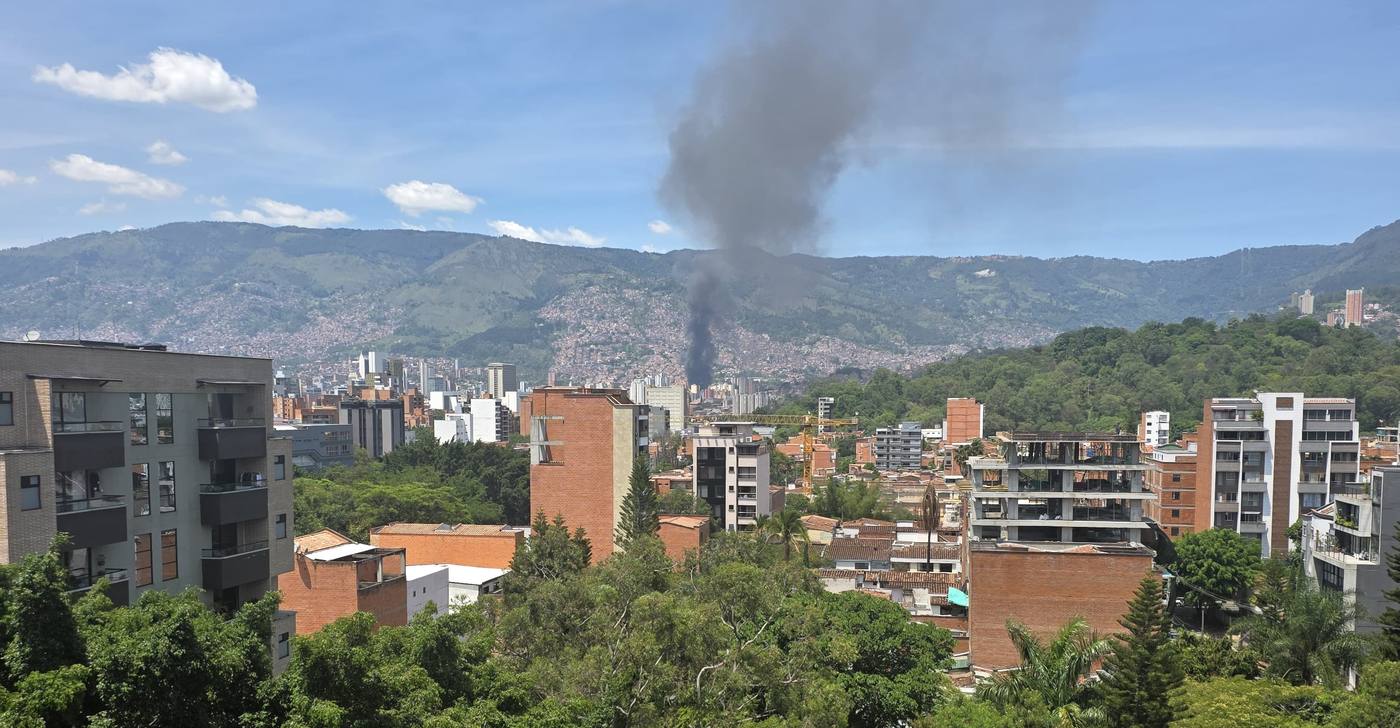
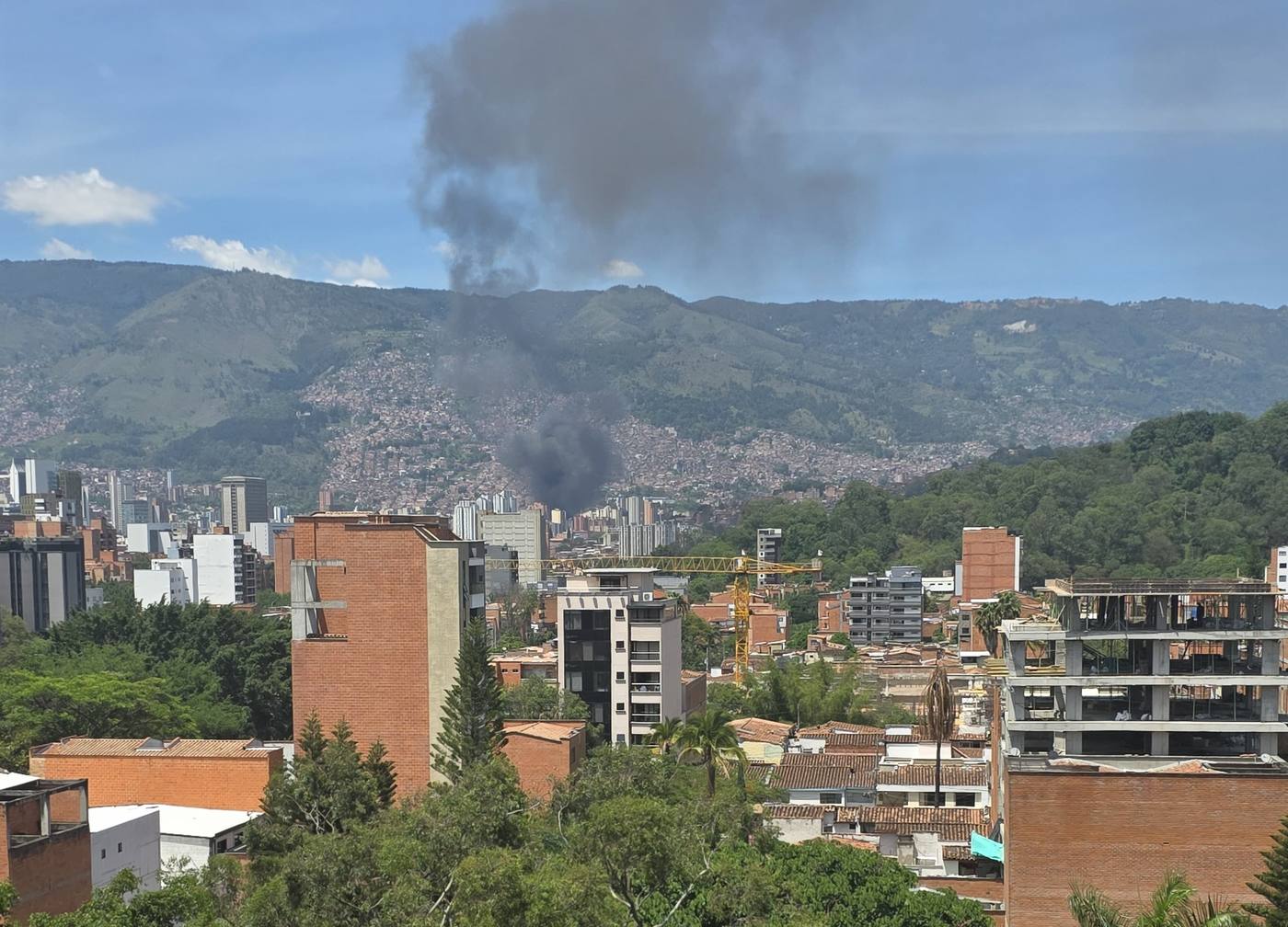
Photographs and video recorded by the Fire Shield team in Medellín. Nothing on this page is staged or stock.


Videos play silently. Use the controls for sound. Neighborhoods are not named, to protect residents' privacy.
Conditions on the ground
What makes a hillside fire different
These are not abstract risk factors. They are the reasons a crew arrives and cannot bring an apparatus close to the fire, or arrives and finds no water within reach.
Field observations from Fire Shield community assessments in Medellín, 2026. Findings for each site are recorded in that community's risk assessment.
- 01High housing density
- 02Closely spaced structures
- 03Steep terrain
- 04Narrow roads and stairways
- 05Limited apparatus access
- 06Limited water availability
- 07Informal electrical systems
- 08Open flame cooking
- 09Mixed combustible construction
- 10Difficult evacuation routes
- 11Limited emergency resources
Every figure on this site is sourced. The full reference list and the resource center live on their own page.
Core program
Fire Service Exchange
Firefighters learning from firefighters
Designed as a standing program rather than a donation drive. Knowledge moves in both directions, and the capability stays where it is needed.
The philosophy
Not exporting a model. Comparing conditions.
Departments face the same fundamentals everywhere: water on the fire, people out of the building, arriving in time. What differs is terrain, staffing, apparatus, water infrastructure, construction and budget.
A tactic that works on a wide suburban street can be impossible on a hillside reached by a lane two meters across. So the exchange starts with firefighters describing their own conditions to each other, and only then decides what is worth adapting.
What departments exchange
- 01Training programs
- 02Operational knowledge
- 03SOPs and best practice
- 04Pre-incident planning
- 05GIS and mapping practice
- 06Prevention strategy
- 07Water supply operations
- 08Incident command
- 09Equipment knowledge
- 10Community risk reduction
- 11Lessons from major incidents
How the exchange is structured
Fire Shield convenes and documents. It does not replace either department and it does not speak for either one. Greensboro Fire Department is the first U.S. partner.
01
U.S. fire department
Training capacity, documented procedure, equipment knowledge, incident experience.
02
Fire Shield
Convenes, translates, handles logistics, documents what was exchanged so it is repeatable.
03
Local partner
Terrain knowledge, local practice, and the judgment about what will actually work.
04
Communities
Faster, better prepared response from a department that keeps the capability.
First exchange partner
Greensboro Fire Department
Fire Shield founder Lamar W. Sullivan with Greensboro Fire Department leadership · Greensboro, North Carolina · 2026
Greensboro is the first department to sit down with Fire Shield and work through what an exchange with Medellín would look like in practice: which training programs travel, which procedures need adapting to hillside conditions, and what the department gains in return.
At a Greensboro Fire Department station · 2026
Built to scale
One pairing becomes a network
The value to a funder is not that one department helped one city. It is that Fire Shield built a repeatable mechanism for moving fire service knowledge across borders.
Is your department interested?
Start with a conversation about your own conditions and capacity. No commitment on the first call.
Partners
Fire resilience requires partnership
Nobody does this alone. Here is who is at the table, and further down, how to join them.
Who we work with
Logos shown with written approval


Your organization
belongs here.
What each partner brings
Fire services
Training, operational expertise, equipment knowledge and mentorship.
Government
Infrastructure, policy, emergency management and coordination.
Communities
Local knowledge, participation, prevention and preparedness.
Universities
Research, engineering, data analysis, GIS and evaluation.
Private sector
Technology, equipment, logistics, expertise and funding.
NGOs and foundations
Community access, humanitarian expertise, funding and program collaboration.
Seen who is here. Now join them.
Seven ways in, matched to what you have to offer.
Resources
Sources, learning and public education
Where our figures come from, what we publish, and material residents and partners can use today.
Research and technical references
What the work is built on
Every source is named with its contribution stated, so anyone can check the reasoning.
| Source | Contribution | Type |
|---|---|---|
| Flórez Trujillo, D. F., Valencia, A., Avendaño-Uribe, B. (2023). Informal Settlement Fires in Colombia. Fire Technology. doi:10.1007/s10694-023-01413-8 | Distills UNGRD national records, 2011 to 2020: 2,540 structural fire events, 432 in informal settlements, 22,563 people affected, 3,489 dwellings destroyed, 35 deaths, 275 injuries. Reports that 88.5 percent of informal settlement fire causes were filed as undetermined or unknown, and that among the 11.5 percent explained, electrical problems (42 percent), food preparation (26 percent) and storage of materials (12 percent) lead. Every headline figure on this site comes from this paper. Scope is national, not Medellín specific. | Paper |
| Flórez Trujillo, D. F. (2024). Simulación computacional del incendio en una vivienda informal colombiana de la región andina mediante Fire Dynamic Simulator. Master's thesis, Universidad Tecnológica de Pereira. Read excerpts → | Computational simulation of fire growth and spread inside an informal Andean dwelling, the physical basis for how fast one ignition becomes a block. | Thesis |
| Flórez Trujillo, D. F. et al. (2023). Numerical simulation of an informal dwelling fire in the Colombian context. LACCEI 2023. Proceedings → | Conference presentation of the simulation work and its implications for safety strategy in informal settlements. | Paper |
| Kindling, Fire Safety Research Institute. Fire safety in informal and humanitarian settlements. Project page → | Fire behavior, ignition and spread in informal settlements. Supports the case for integrating prevention, infrastructure and response rather than treating them separately. | Project |
| Westminster University graduate research, IPSL Global Engagement. Program page → | Graduate research supporting implementation, evaluation, GIS analysis and a community fire resilience model that can be adapted elsewhere. | Thesis |
| National Fire Protection Association. nfpa.org → | Standards and practice for fire prevention, life safety, community risk reduction and emergency response. | Standard |
| U.S. Fire Administration, FEMA. usfa.fema.gov → | Community risk reduction methodology, firefighter safety guidance and public education resources. | Agency |
| International Association of Fire Chiefs. iafc.org → | Leadership principles, emergency management practice and operational guidance for modern fire services. | Body |
| Fire Shield field assessments, Medellín. See the field → | Local mapping, stakeholder engagement and community risk assessments in pilot communities, used to test whether the published findings hold on the ground. | Field |
Listing a source does not imply affiliation with, or endorsement by, that organization.
Resource center
Grows as material is publishedThe research we build on
Informal Settlement Fires in Colombia
The figures on this site come from a 2023 peer reviewed paper in Fire Technology, lead authored by Diego Fernando Flórez Trujillo of the Universidad Tecnológica de Pereira with co-authors at the University of Canterbury. It distills Colombia's national disaster records for 2011 to 2020 and is the first systematic account of informal settlement fires in the country. His follow on work simulates how fire grows inside an informal Andean dwelling built from guadua bamboo and esterilla, which is the physical basis for how fast one ignition becomes a block.
Citing published research does not imply the authors' or the university's endorsement of Fire Shield.
Documents
- Informal Settlement Fires in Colombia, Fire Technology, 2023Open at publisher →
- The 2024 thesis in fifteen minutes, reading versionRead →
- Master's thesis, Universidad Tecnológica de Pereira, 2024Open →
- Water Shield program proposal, Medellín, July 2026Read →
- Water Shield deck, English and SpanishView slides →
- Fire Shield Foundation overview deckView slides →
- Fire Shield capability statementOpen →
- Numerical simulation of an informal dwelling fire, LACCEI 2023Open at LACCEI →
Every document opens in the Fire Shield documents room, where the files can also be downloaded.
Public education
Fire safety for families and schools
Short bilingual videos and practical guides, built for the homes people actually live in.
Cooking safety
Electrical safety
Getting out safely
Need an extinguisher?
Write to lamars@fireshieldfoundation.org with your neighborhood and we coordinate delivery and a short demonstration through the community brigade.
Need a smoke detector?
Detectors are distributed and installed during community prevention sessions. Email us to have your block included.
Tell us about your neighborhood
A short survey on access, water and hazards where you live. It feeds the community risk assessment directly.
Questions people ask
Impact
This page exists before the numbers do
Every measure shows the record that produces it and its current status, and the status means what it says.
Reporting commitment
Figures update on a quarterly basis once programs are running. Where a number changes, the superseded version stays available in the report archive.
What we track
| Measure | Record behind it | To date | Status |
|---|---|---|---|
| Communities assessed | Field assessment on file | — | Not started |
| Residents reached | Session attendance records | — | Not started |
| Firefighters trained | Certificates issued | — | Not started |
| Training hours delivered | Instructor logs | — | Not started |
| Fire departments engaged | Signed exchange agreements | 1 | In progress |
| Equipment donated | Receipt and handover records | — | Not started |
| Water resources identified | GIS layer, verified on site | — | In progress |
| Structures mapped | GIS layer | — | In progress |
| Community fire plans developed | Plan document, community signed | — | Not started |
| International partnerships created | Written agreement in place | 4 | Reporting |
Each row names the record that produces the number: an assessment on file, an attendance sheet, a certificate issued, a signed agreement, a verified GIS layer. Nothing is counted twice, nothing is estimated, and a measure with no record behind it stays at zero until there is one.
Progress against the targets
No percentage is published here until a baseline exists to measure it against.
Baselines have to be established with the local fire service and a research partner before a percentage means anything. Baseline work began in Medellín in 2026.
Funding a measure on this page
Pick a row. We will tell you what it costs to move it and what evidence comes back.
Get involved
Six ways in, and they are not interchangeable
Pick the one that matches what you actually have to offer. Each route goes to a different conversation.
01
Fire departments
Share training, operational knowledge, SOPs, equipment and expertise through the Fire Service Exchange.
02
Corporate partners
Support equipment, technology, transportation, infrastructure or program funding. We will tell you which pillar it lands in and how it gets reported.
03
Universities and researchers
Collaborate on research, GIS, engineering, data analysis and evaluation. We especially need partners to help establish the baselines behind the targets, and there is a specific equipment and compute list below.
04
Community organizations
Help identify needs and implement solutions that fit local conditions. Residents are part of fire protection, not recipients of it.
05
Firefighters and professionals
Contribute instruction, GIS, engineering, logistics, translation or grant writing. Remote contribution is real contribution.
06
Volunteer firefighters
Join a community brigade or a partner department's volunteer program. Training, equipment and the terms of service are set with the local fire service. Write to us and we match you with the nearest program.
07
Government agencies
Coordinate on infrastructure, emergency management, policy and access to the communities that carry the most risk.
For laboratories, companies and universities
What the research actually needs
The fire science behind this work is done at a Colombian public university on a budget that cannot buy the instruments. These are the specific gaps.
01
Instruments and bench testing
High temperature sensors, heat flux transducers, thin skin calorimeters, thermographic equipment and data acquisition systems. Access to cone calorimetry or a fire propagation apparatus for material pyrolysis characterization. Donated or loaned hardware moves this immediately.
02
Software and compute
Licensing for fire simulation tools such as PyroSim, and time on high performance or cloud computing to run multi mesh CFD simulations of dwelling fires. A company with spare compute can fund a year of modeling for very little.
03
Field validation and students
Funding for test specimens and field campaigns in vulnerable communities, open access publishing, and co advised thesis projects, research stays and virtual mentorship for undergraduate and graduate engineering students. Standardized post incident investigation protocols are the single most requested item, because 88.5 percent of these fires currently have no recorded cause.
Priorities identified in conversation with fire researchers at Universidad Tecnológica de Pereira, September 2026. Joint grant proposals with bodies such as NIST or NFPA, equipment donations and technical exchanges are the three routes that help most.
Donate
Your support builds capability
Here is where the money goes and what it buys. Fire Shield Foundation, Inc. is a U.S. 501(c)(3) public charity and contributions are tax deductible to the extent permitted by law.
- Fire prevention and educationPillar 01
- Community preparednessPillar 01
- Water and infrastructurePillar 03
- GIS and mappingPillar 03
- Firefighter trainingPillar 02
- Tools and equipmentPillar 02
- Research and evaluationAll three
Named campaigns
First campaign · ground zero
Comuna 3, Manrique
The first community Fire Shield works in end to end: assessment, prevention, mapping, brigade equipment and response. Comuna 3 sits on the northeastern slopes of Medellín, where dense self built housing, steep lanes and limited water access make it one of the city's highest fire risk areas. The campaign funds the community risk assessment, prevention sessions in Spanish, water point mapping, and the equipment and training for a community brigade.
Every gift to this campaign stays in Comuna 3
Equip a community brigade
Helmets, gloves, hose, nozzles, extinguishers and radios for a ten person volunteer brigade, plus the training to use them.
Fund a training program
Instructor time, materials and certification for one cohort of firefighters through the Fire Service Exchange.
Fund a risk assessment
A full field assessment of one community: hazards, access, water, structures and evacuation routes, mapped in GIS and shared with the local fire service.
Help equip a department
Tools, PPE and technology that a partner fire department can maintain locally, chosen with the crews who will use them.
Start a conversation
Make a contribution
Card, bank or PayPal balance. PayPal emails a receipt. Fire Shield Foundation, Inc. is a U.S. 501(c)(3) public charity.
Scan to give
Bank transfer in U.S. dollars or Colombian pesos: write to lamars@fireshieldfoundation.org and we send the account details. Zelle and bank transfers do not generate an automatic receipt; email us the confirmation and we send one.
Build fire resilience with us
Some communities do not need another organization telling them what they need. They need access to the knowledge, resources and partnerships that let them build their own.